Generative Engine Optimization Audit
When a customer asks ChatGPT, Claude, Perplexity, or Google AI for a recommendation in your industry, does your business show up? For most small businesses, the answer is no. Generative Engine Optimization (GEO) is the practice of making your site visible and citable to AI search engines. We measure it, fix it, and track it.
What GEO Actually Is
GEO stands for Generative Engine Optimization. It is the practice of making a website visible to AI-powered search engines including ChatGPT, Claude, Perplexity, Gemini, Google AI Overviews, and Bing Copilot. These engines give direct answers to user questions and cite specific sources, rather than returning a list of blue links. If your site is not structured the way they expect, you are invisible to them, even if you rank well on traditional Google search.
Traditional SEO optimizes for keyword ranking on a search results page. GEO optimizes for being cited as a source inside an AI-generated answer. The two overlap on content quality and schema markup, but they diverge sharply on several specifics:
- robots.txt signals for AI crawlers - most sites block or ignore GPTBot, ClaudeBot, PerplexityBot, Google-Extended, and 20+ other AI agents. Each one has to be explicitly addressed.
- llms.txt - a spec-compliant file that tells AI systems which pages matter and how the content is organized. Very few sites have this.
- AI discovery endpoints - /.well-known/ai.txt, /ai/summary.json, /ai/faq.json, /ai/service.json. Structured entry points for AI agents.
- Passage-level citability - AI engines cite 100-170 word passages. Most sites are either too thin or too sprawling for that window.
- Brand entity signals - sameAs links to Wikipedia, Wikidata, LinkedIn, Crunchbase, G2, Reddit, and more. These tell AI models who you are.
- JSON-LD structured data - WebSite, Organization, FAQPage, Service, Product schema at minimum. Many sites have none.
Ignore this stack and you leave your AI search visibility to chance. Address it deliberately and you move from the 20-30 point (critical) band into the 70-90 point (good to excellent) band, typically within 30 to 90 days.
What Is In the Free Audit Report
Every engagement starts with a full GEO audit. The report is a deliverable in its own right: professionally formatted, easy for an owner or operator to read, and directly actionable. Here are the before and after reports from our very own site, placed side by side so you can scroll page-by-page through both. The baseline audit found eaglepointpublishing.com at 31 out of 100 (critical). We estimated the fix playbook would lift the score into the 65 to 75 range; the actual post-fix re-audit came back at 81 out of 100 (good tier), a +50 point delta. The fix plan executed 27 prioritized changes across six audit categories: AI crawler allowlist for 25 bots, spec-compliant llms.txt rewrite, full JSON-LD schema graph (WebSite, Organization, FAQPage, Service), AI discovery endpoints, content restructuring and expansion, canonical and og tag rollout, brand entity anchor prep, platform-specific optimizations, and post-fix verification. Every step followed a repeatable playbook we can run on your site. We under-promised and over-delivered on our own domain. That is the same posture B3 will bring to your engagement.
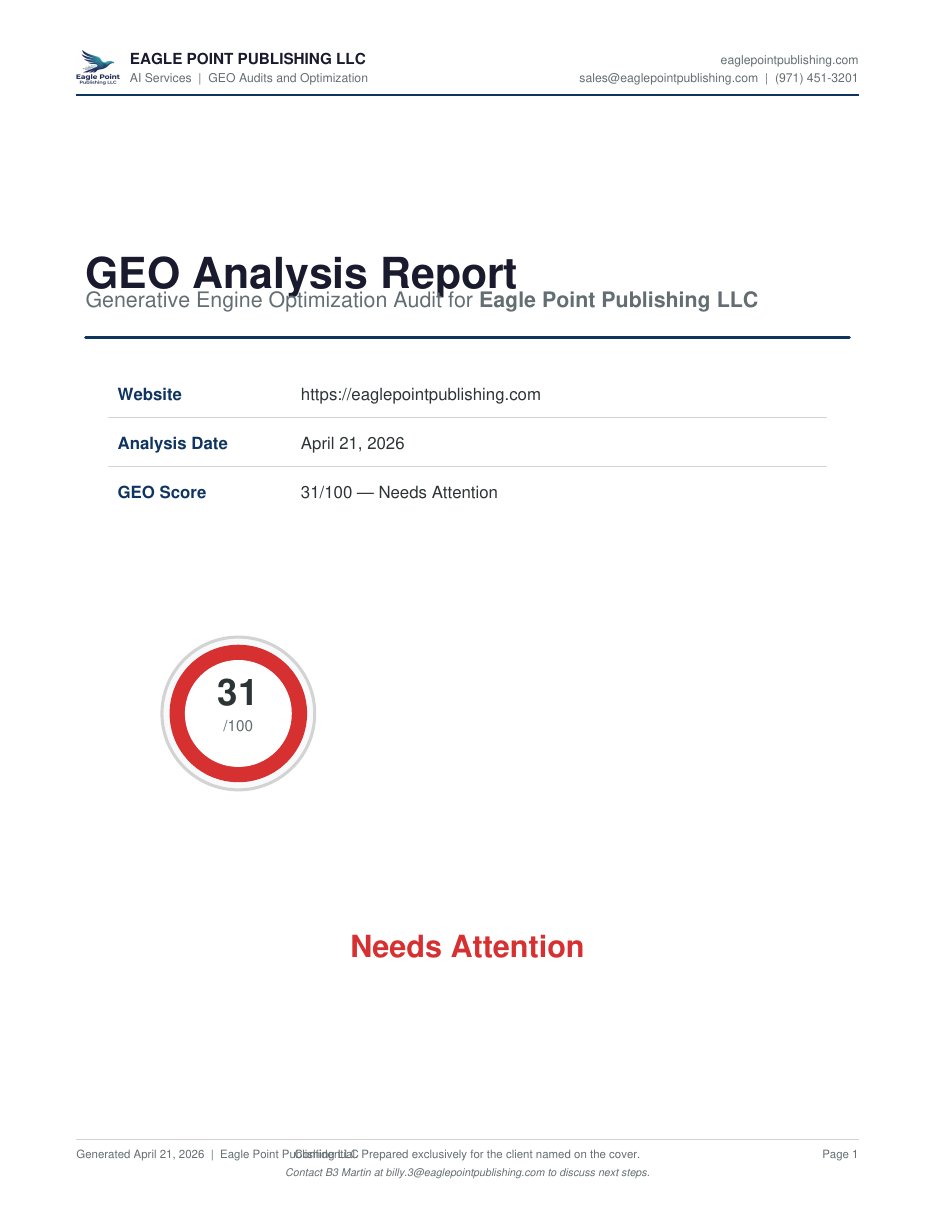
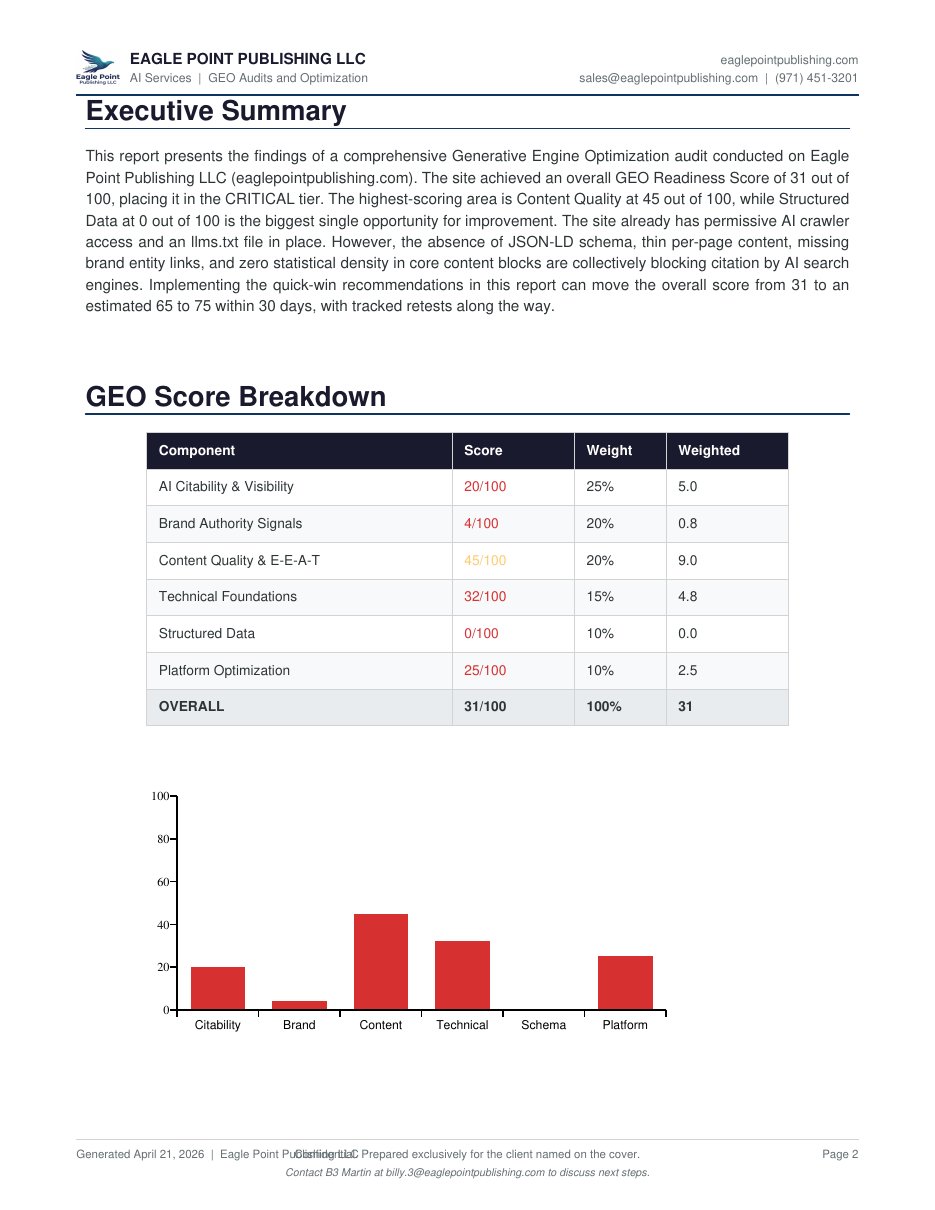
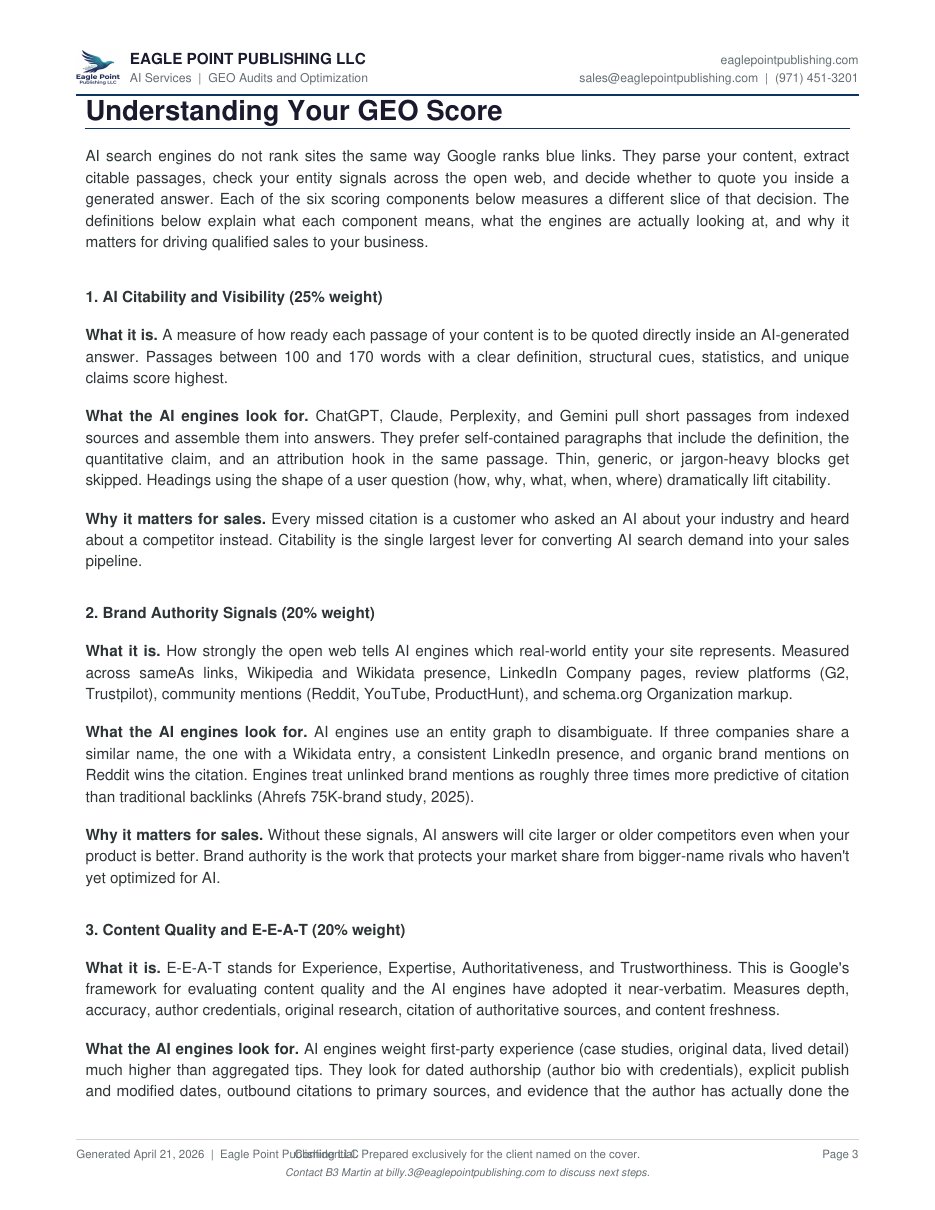
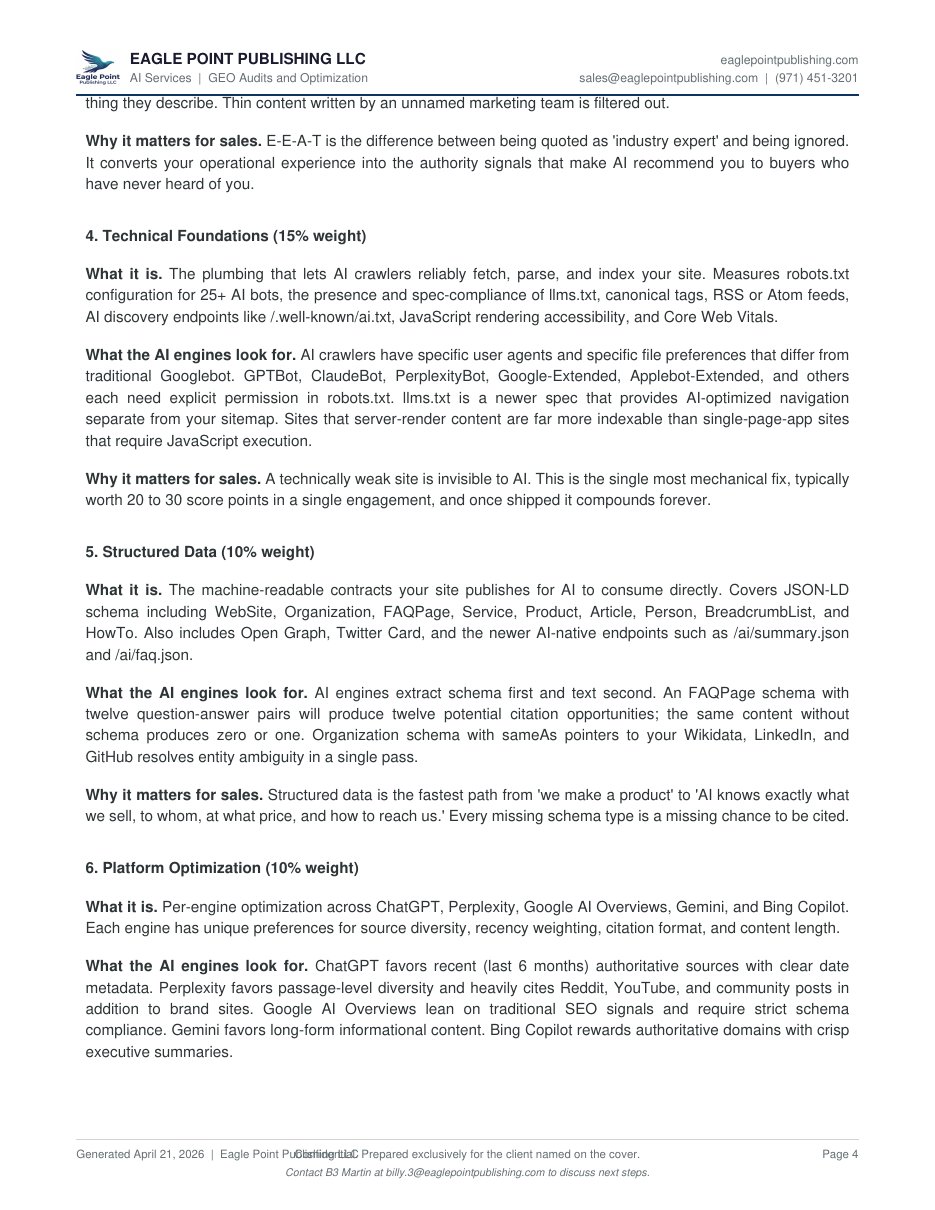
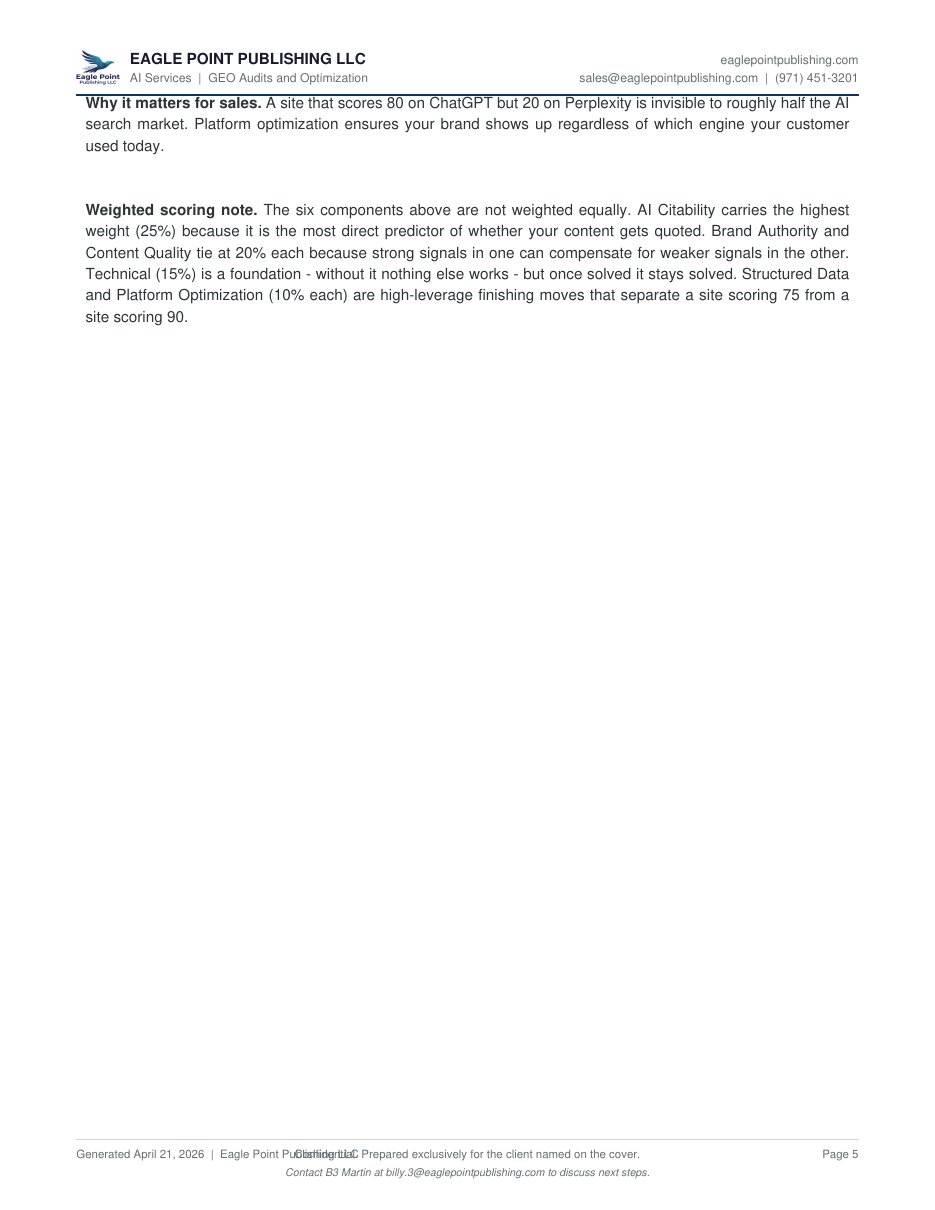
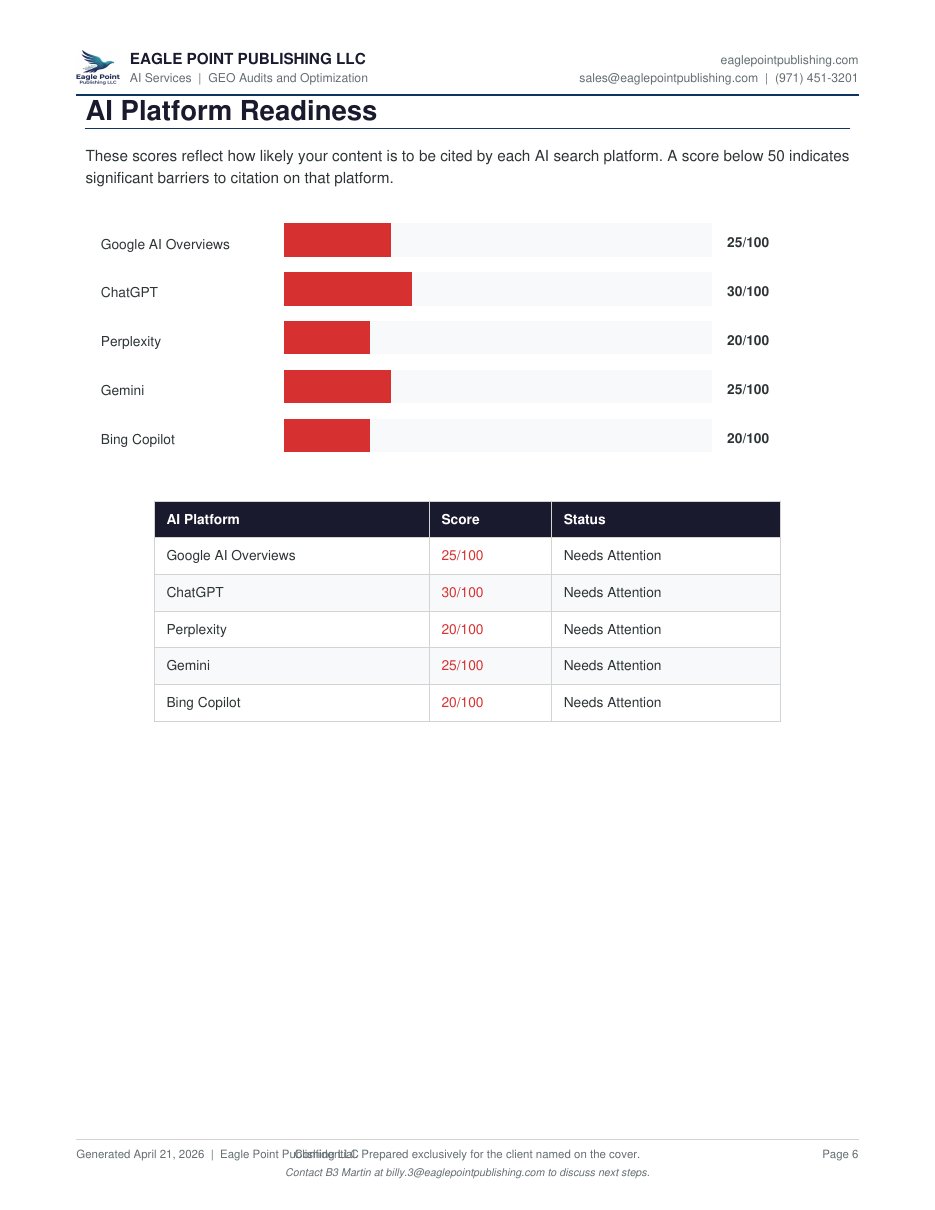
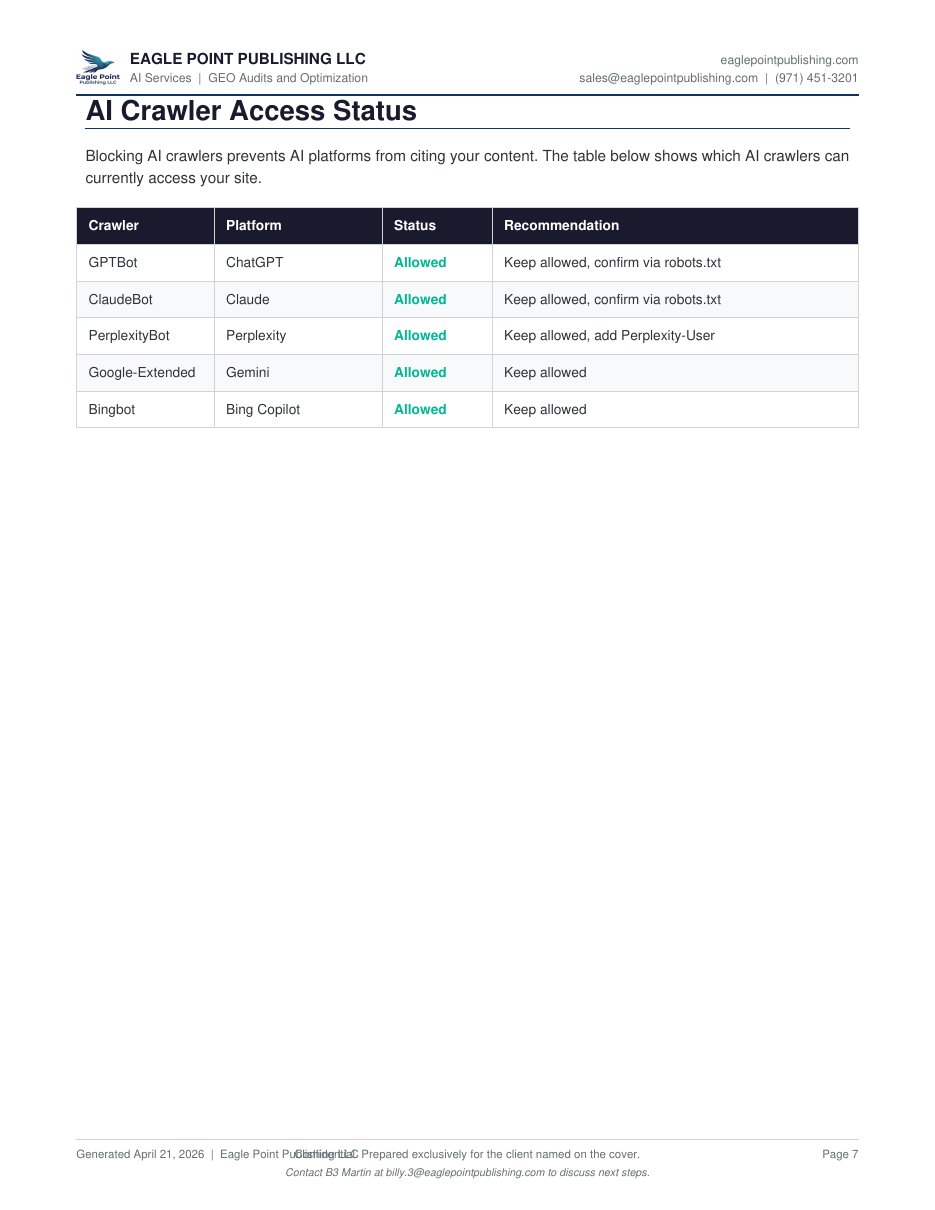
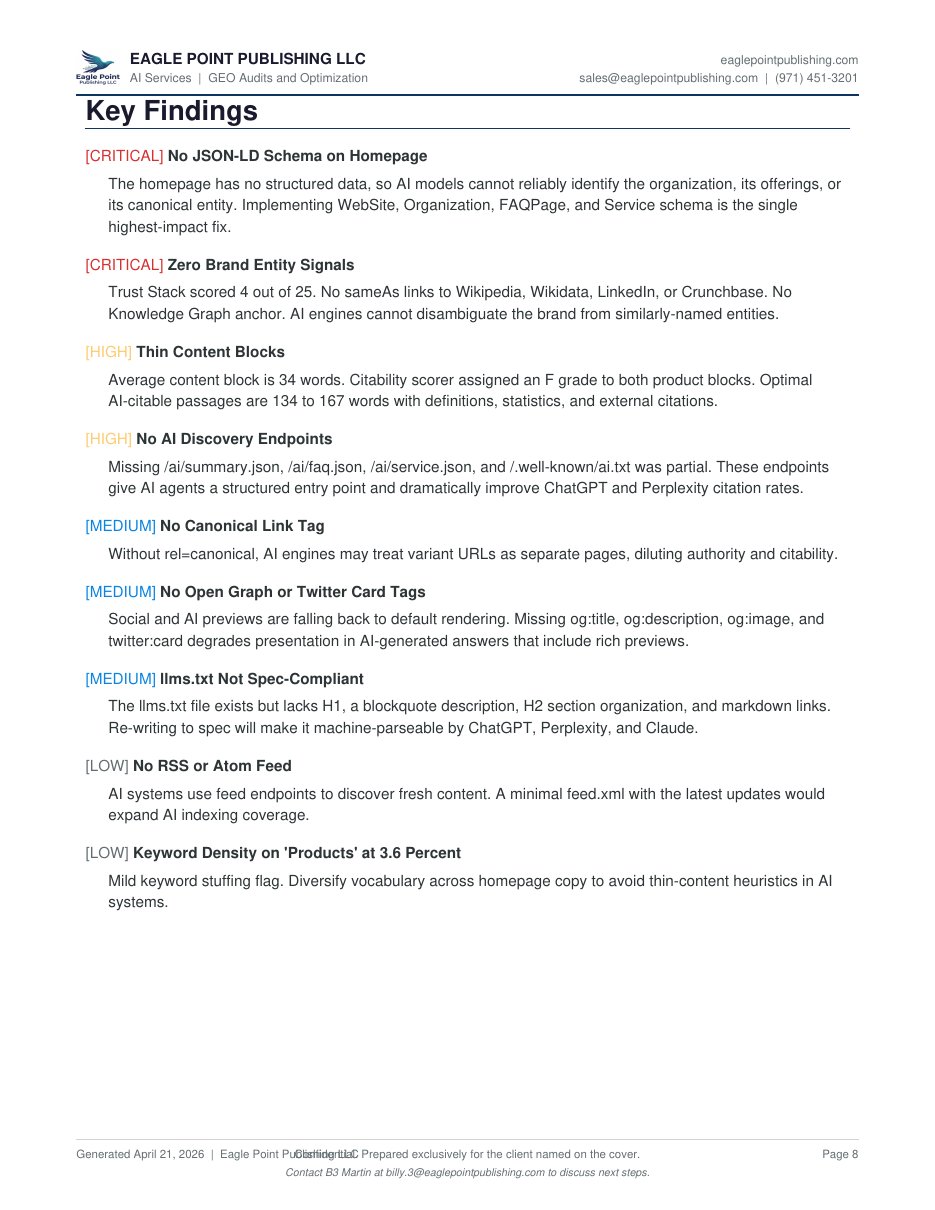
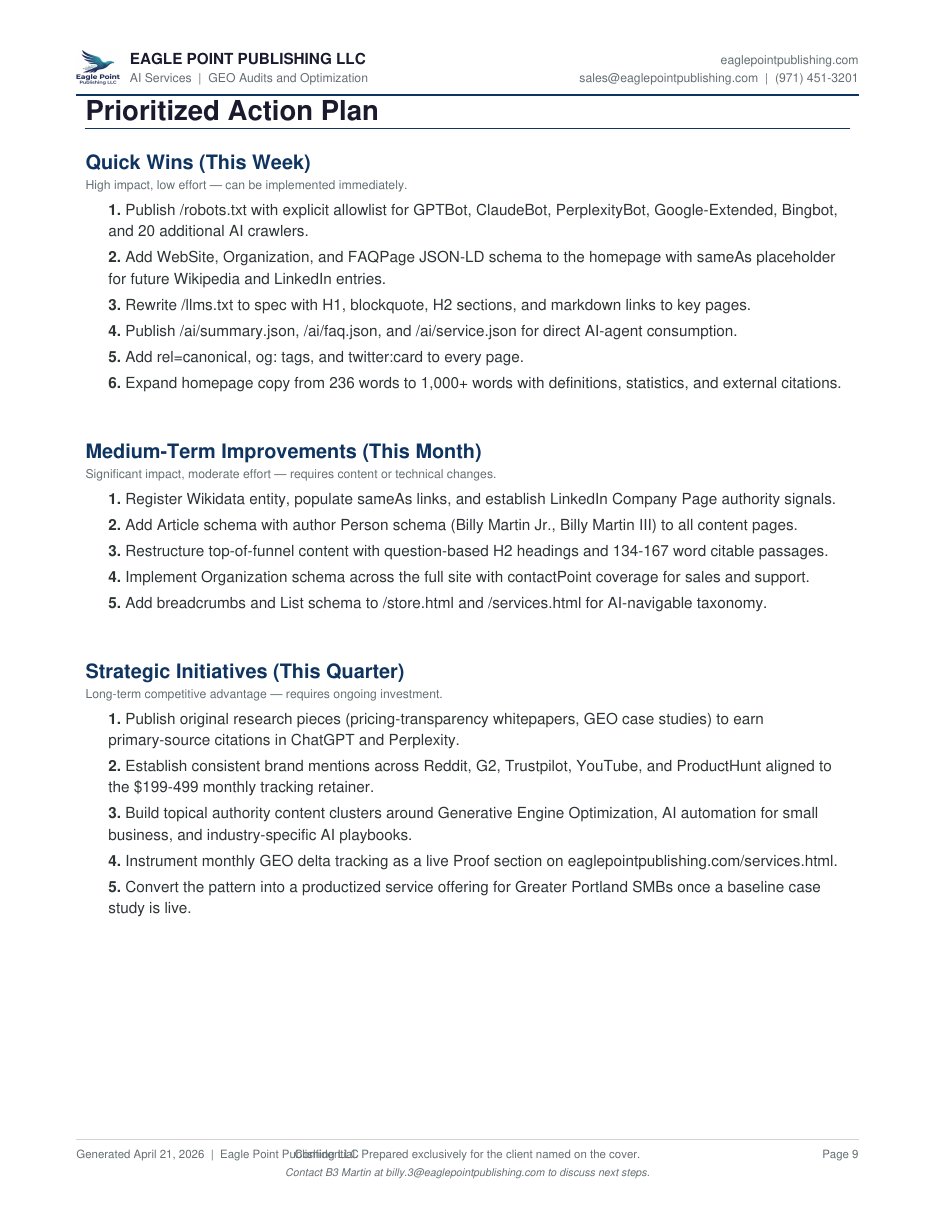
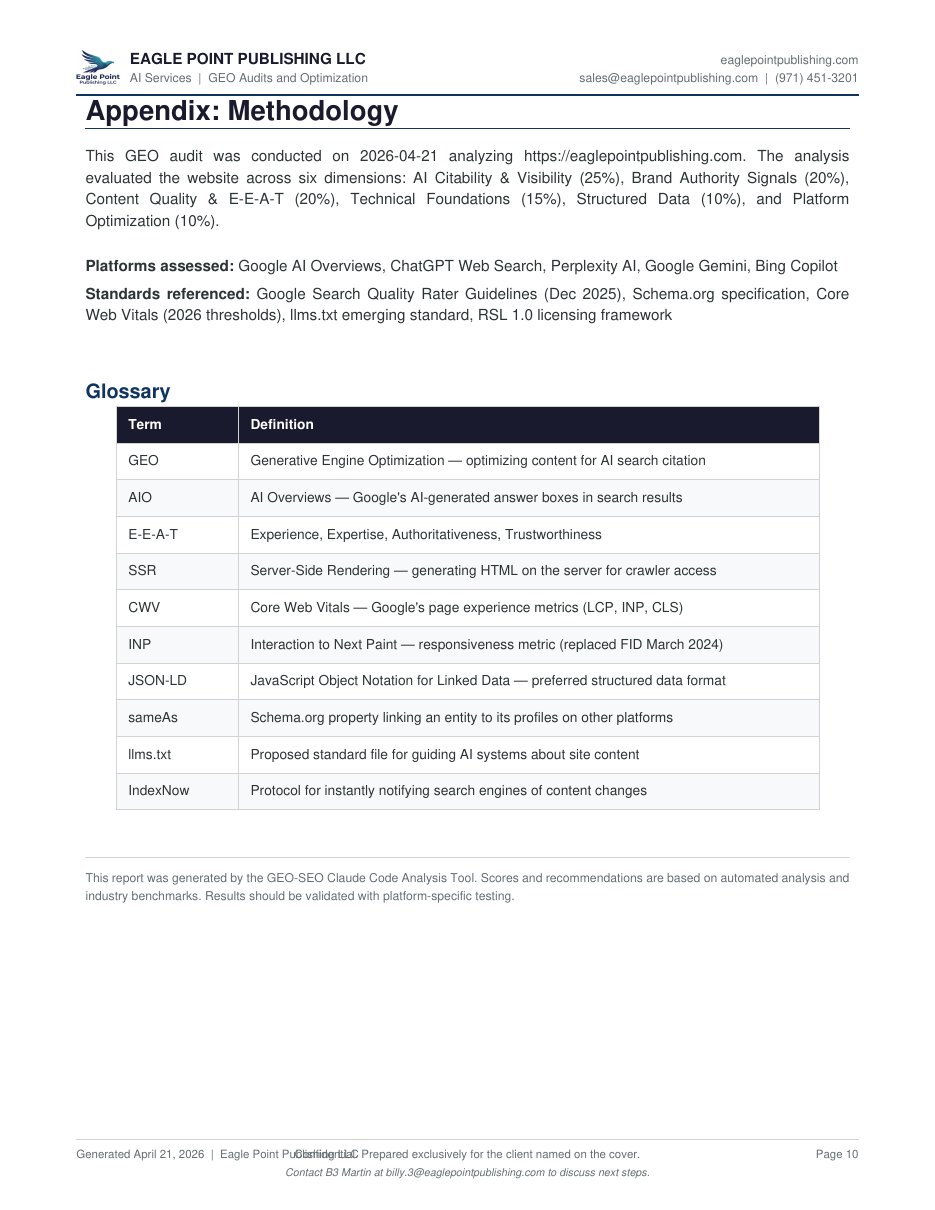


Both reports step together, page by page, so you can compare the same section before and after the fix plan.
What Is Inside
- Overall GEO Readiness Score, 0 to 100, with the tier band (critical, foundation, good, excellent).
- Six category sub-scores: AI Citability, Brand Authority, Content Quality and E-E-A-T, Technical, Schema, and Platform Optimization.
- Per-platform readiness scoring for ChatGPT, Perplexity, Google AI Overviews, Gemini, and Bing Copilot. Each engine scored independently.
- Executive summary in plain English suitable for the owner, operator, or a non-technical stakeholder.
- Severity-ranked findings: critical, high, medium, and low. Each finding includes what it is, why it hurts visibility, and the fix.
- Prioritized action plan split into quick wins for this week, medium-term fixes for this month, and strategic initiatives for this quarter.
- AI crawler access table showing status (Allowed, Blocked, Missing) for each major AI agent and the recommendation for each.
- Content citability analysis with specific passages scored and ranked, showing exactly which blocks the AI engines find quotable.
- Trust Stack score covering technical, identity, social, academic, and consistency trust signals.
What Does Your Score Actually Mean?
The 0 to 100 GEO score maps to four bands, defined by the underlying audit tooling. Each band describes the observed behavior of AI search engines when deciding whether to cite your site. The bands are not our opinion; they are how the scoring methodology (backed by Princeton KDD 2024 and AutoGEO ICLR 2026 research) labels the observed signals.
Where the data is strong: the bands reflect measurable, objective signals (robots.txt config, schema presence, citability scoring, entity graph coverage). Where we will not invent numbers: there is no published study that says \"score 81 = X percent chance of citation on any given query.\" Citation rates vary by industry, query volume, competitive set, and how often your customers search on AI in the first place. Ask anyone selling you a specific percentage and check their source.
The site is effectively invisible to AI search engines. When a customer asks ChatGPT, Claude, Perplexity, Gemini, or Google AI for a recommendation in your industry, your site does not appear in the answer. Competitors with higher scores absorb the demand.
Basic AI-visibility infrastructure is in place. The site is occasionally referenced for tail queries but is rarely the primary or preferred source. AI engines know you exist but do not yet trust you as a default citation for your core keywords.
The site is a reliable source on your core queries. AI engines cite you regularly when customers search in your industry. Brand-direct queries resolve to your site consistently. Some specialized or long-tail queries still favor competitors.
The site is a default reference for your category across multiple AI engines. Brand, category, and comparative queries routinely cite you. This is the zone where AI search becomes a measurable sales channel rather than a slow-burn visibility play.
Honest ROI framing
The industry numbers below are verifiable, published, and independent of our service. Use them to frame the opportunity for your own business. We will never quote you a citation-rate uplift number that we cannot cite.
- AI search traffic growth: 527 percent year over year (multiple industry reports, 2025-2026)
- Conversion rate on AI-referred traffic vs organic: 4.4x higher (multiple ecommerce tracking studies, 2026)
- Marketers actively investing in GEO today: 23 percent (first-mover opportunity window)
- Projected search traffic drop by 2028 if unoptimized: 50 percent (Gartner)
Translation: AI search is growing fast, converts better than Google organic, and the majority of competitors have not started. Moving from the critical band to the excellent band does not guarantee a specific revenue number. It does materially change whether an AI engine recommends you or a competitor when a customer asks. The math of whether that is worth the investment is specific to your sales cycle, average order value, and customer acquisition cost. We will walk through your math on the free consult.
Why You Need This Now
Three things are happening at once:
- Your customers are already searching on AI. ChatGPT, Claude, Perplexity, and Gemini have compressed the search market in under two years. People ask, they get an answer, and most of them never click a source link. If you are not in the answer, you are not in the purchase consideration.
- Most competitors have not optimized. Only about 23 percent of marketers are actively investing in GEO. The window where a small business can leapfrog larger rivals on AI visibility is open right now and will not stay open.
- The signals compound. Schema, brand mentions, citations, and content citability all reinforce each other. Sites that start early build a durable moat. Sites that wait keep losing ground month over month.
GEO is not a one-time gimmick. It is the same shift SEO was in the early 2000s, compressed into a two-to-three-year window. Sites that treat it seriously now will dominate AI-referred traffic for years. Sites that do not will be invisible.
The report is free. What you do with it is up to you.
We build your full GEO audit and hand it to you as a finished, owner-ready deliverable at no cost. It is yours to keep. Most of what it surfaces is fixable by anyone willing to put in the time, so we tell you exactly what is wrong, and you choose how it gets fixed.
Take it and run
Do it yourself.
- The report lists every finding, ranked by impact, in plain language.
- Each item explains what is wrong and what “fixed” looks like.
- Work through the changes and AI engines start citing you. No strings, nothing to buy.
Have us do it
Short on time or technical resources?
- If you would rather not spend the hours, we have the skills and the team.
- We put together a reasonable, scoped proposal to clean up the findings for you.
- You decide afterward. The audit stands on its own either way.
Either path starts the same way: a free GEO report on your business. Book a quick call and we will run it.
Case study: our own site
Before we started selling this service, we ran it on ourselves. Baseline on eaglepointpublishing.com was 31 out of 100 - critical tier, invisible to AI search. Our fix plan executed 27 prioritized changes across six audit categories: AI crawler allowlist for 25 bots, spec-compliant llms.txt rewrite, full JSON-LD schema graph, AI discovery endpoints, content restructuring and expansion, canonical and og tags, brand entity anchors, and platform-specific optimizations. Each change was audited against the underlying methodology (Princeton KDD 2024, AutoGEO ICLR 2026). Post-fix re-audit: 81 out of 100, good tier. A +50 point delta.
Per-platform improvements from the same session:
- ChatGPT readiness: 30 to 80 (+50)
- Perplexity: 20 to 70 (+50)
- Google AI Overviews: 25 to 80 (+55)
- Gemini: 25 to 75 (+50)
- Bing Copilot: 20 to 70 (+50)
We will not promise the same delta on every site. Every domain starts from a different baseline and has different content constraints. What we will promise is transparency: you get the real baseline, the real fixes, and the real post-fix re-audit. No cherry-picked numbers.
Ready to see your number?
Fifteen-minute free consult. We will look at your site, tell you a ballpark score, and hand you the findings. No obligation, no pressure.
Schedule a Free ConsultOr email B3 directly at [email protected]